
Uddeholm SLEIPNER
Uddeholm Sleipner steel is a high-alloy cold work tool steel combining high hardness, very good wear resistance and enhanced toughness, widely used in knifemaking.



|
Thickness [mm]
|
Width [mm]
|
Length [mm]
|
Price without tax
|
Tax
|
Price
|
Available
|
Order quantity
|
|
|
|
|
|
|
|
|
|
||||
| 22.59 zł | 23 % | 27.79 zł | 56 | ||||||
| 27.27 zł | 23 % | 33.54 zł | 46 | ||||||
| 31.16 zł | 23 % | 38.33 zł | 40 | ||||||
| 35.84 zł | 23 % | 44.08 zł | 35 | ||||||
| 44.41 zł | 23 % | 54.62 zł | 28 | ||||||
| 29.60 zł | 23 % | 36.41 zł | 42 | ||||||
| 35.06 zł | 23 % | 43.12 zł | 36 | ||||||
| 41.28 zł | 23 % | 50.78 zł | 30 | ||||||
| 46.74 zł | 23 % | 57.49 zł | 27 | ||||||
| 58.42 zł | 23 % | 71.86 zł | 21 | ||||||
| 36.61 zł | 23 % | 45.03 zł | 34 | ||||||
| 43.63 zł | 23 % | 53.66 zł | 29 | ||||||
| 51.41 zł | 23 % | 63.24 zł | 24 | ||||||
| 58.42 zł | 23 % | 71.86 zł | 21 | ||||||
| 72.45 zł | 23 % | 89.11 zł | 17 | ||||||
| 43.63 zł | 23 % | 53.66 zł | 29 | ||||||
| 52.20 zł | 23 % | 64.20 zł | 24 | ||||||
| 60.76 zł | 23 % | 74.74 zł | 20 | ||||||
| 69.33 zł | 23 % | 85.28 zł | 18 | ||||||
| 87.25 zł | 23 % | 107.32 zł | 14 | ||||||
| 50.63 zł | 23 % | 62.28 zł | 25 | ||||||
| 60.76 zł | 23 % | 74.74 zł | 20 | ||||||
| 70.89 zł | 23 % | 87.19 zł | 17 | ||||||
| 81.02 zł | 23 % | 99.65 zł | 15 | ||||||
| 101.27 zł | 23 % | 124.56 zł | 12 | ||||||
| 57.64 zł | 23 % | 70.90 zł | 21 | ||||||
| 69.33 zł | 23 % | 85.28 zł | 18 | ||||||
| 81.02 zł | 23 % | 99.65 zł | 15 | ||||||
| 91.92 zł | 23 % | 113.06 zł | 13 | ||||||
| 115.29 zł | 23 % | 141.81 zł | 11 | ||||||
| 70.11 zł | 23 % | 86.24 zł | 18 | ||||||
| 77.90 zł | 23 % | 95.82 zł | 16 | ||||||
| 93.48 zł | 23 % | 114.98 zł | 13 | ||||||
| 109.06 zł | 23 % | 134.14 zł | 11 | ||||||
| 132.43 zł | 23 % | 162.89 zł | 9 | ||||||
| 77.90 zł | 23 % | 95.82 zł | 16 | ||||||
| 85.69 zł | 23 % | 105.40 zł | 14 | ||||||
| 101.27 zł | 23 % | 124.56 zł | 12 | ||||||
| 116.85 zł | 23 % | 143.73 zł | 10 | ||||||
| 148.01 zł | 23 % | 182.05 zł | 8 | ||||||
| 93.48 zł | 23 % | 114.98 zł | 13 | ||||||
| 109.06 zł | 23 % | 134.14 zł | 11 | ||||||
| 124.64 zł | 23 % | 153.31 zł | 10 | ||||||
| 148.01 zł | 23 % | 182.05 zł | 8 | ||||||
| 179.17 zł | 23 % | 220.38 zł | 7 | ||||||
| 109.06 zł | 23 % | 134.14 zł | 11 | ||||||
| 132.43 zł | 23 % | 162.89 zł | 9 | ||||||
| 155.80 zł | 23 % | 191.63 zł | 8 | ||||||
| 171.38 zł | 23 % | 210.80 zł | 7 | ||||||
| 218.12 zł | 23 % | 268.29 zł | 5 | ||||||
| 148.01 zł | 23 % | 182.05 zł | 8 | ||||||
| 171.38 zł | 23 % | 210.80 zł | 7 | ||||||
| 202.54 zł | 23 % | 249.12 zł | 6 | ||||||
| 233.70 zł | 23 % | 287.45 zł | 5 | ||||||
| 288.23 zł | 23 % | 354.52 zł | 4 | ||||||
| 637.40 zł | 23 % | 784.00 zł | 2 |


OUR STEEL IS FOR YOU, IF:
| You value precisely cut material We cut steel using band saws, ensuring straight edges. We do not use guillotine shears, which can warp sheets and round their edges. |
|
| Minor scratches or residue are not an issue for you Sometimes, a single steel sheet passes through the saw multiple times, which may cause slight surface scratches. Occasionally, delicate spot traces of surface corrosion (thin residue) may appear on the steel due to coolant remnants from the cutting process. Both scratches and residue can be easily removed during grinding. If you require steel with a perfectly clean surface, our product will not meet your expectations. |
|
| You can straighten minor surface deviations yourself We strive to deliver perfectly flat steel pieces, but we cannot guarantee 100% flatness. Any slight surface curvature is not a material defect but rather a result of mill tolerances (flatness tolerances for rolled products). An experienced knifemaker can handle such a curvature in no time. |
|
| You want to buy steel from trusted supplier We source our steel from the largest manufacturers in Europe and beyond. Each delivery is precisely marked with an industrial hand jet printer to prevent errors during cutting and storage. |
|
| You don't like overpaying Our mission is to provide you with a piece of steel that is as close as possible to the shape of the knife you want to make. With us, you don't have to buy a large piece of steel and make unnecessary supplies or throw unnecessary surpluses in the trash. |
Example photo of a steel sheet:
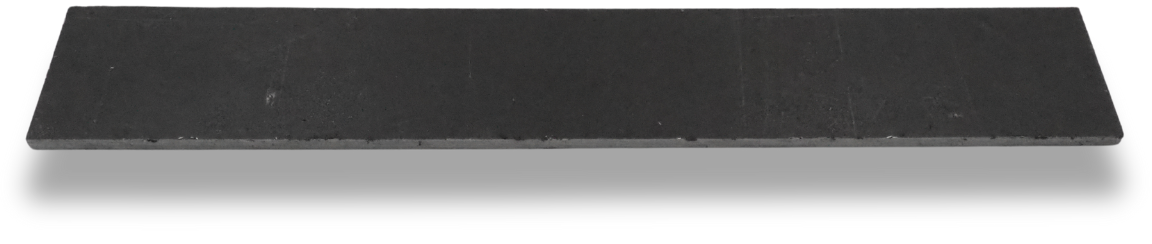
Basic parameters:
- Thickness tolerance: 0/+0,4 mm (the surface is not precision ground)
- Cutting tolerance: we cut the steel on band saws to a tolerance of 0/+3 mm (width x length)
- Delivery conditon: steel in non-hardened condition (steel requires hardening)
Sleipner Steel – The Perfect Choice for Durable Knives
Sleipner steel from Uddeholm is a high-performance tool steel valued by knifemakers for its well-balanced properties. It is known for its excellent wear resistance, toughness, and hardness, making it an ideal material for producing hunting and outdoor knives. Below are presented the chemical composition, heat treatment, achieved hardness, and a comparison of Sleipner steel with other steels used in knifemaking.
Chemical Composition of Sleipner Steel – What Makes It Unique?
| Element |
Composition |
| Carbon (C) | 0,90% |
| Manganese (Mn) |
0,50% |
| Silicon (Si) | 0,90% |
| Chromium (Cr) | 7,80% |
| Molybdenum (Mo) | 2,50% |
| Vanadium (V) | 0,50% |
Sleipner steel features a unique chemical composition that ensures optimal toughness, wear resistance, and hardness. Its chemical composition includes:
- Carbon (C): 0.9% – Increases hardness and hardenability of the steel.
- Chromium (Cr): 7.8% – Enhances wear and corrosion resistance.
- Molybdenum (Mo): 2.5% – Improves hardenability and wear resistance.
- Vanadium (V): 0.5% – Increases toughness and stability of the cutting edge.
- Silicon (Si): 0.9% – Enhances the steel's elasticity.
- Manganese (Mn): 0.5% – Adds hardenability and strength.
The balanced composition of Sleipner steel provides a combination of toughness, wear resistance, and edge stability, making it highly suitable for demanding cutting tasks.
Heat Treatment of Sleipner Steel
Heat treatment difficulty shown at the top of this page reflects the most common choice in our survey of Polish knifemakers, prepared with input from an experienced heat treater. Please treat it as community guidance, not a specification.
“EASY-TO-HARDEN” denotes a more forgiving steel — one that delivers predictable, useful results even with minor deviations in process parameters.
“DIFFICULT-TO-HARDEN” calls for tight process control; small mistakes can quickly degrade the final outcome.
LEGAL NOTICE REGARDING HEAT TREATMENT
Heat treatment is a set of processes dependent on many variables, including knife thickness, the type of furnace and process atmosphere, soaking time and temperature, the method and temperature of cooling, as well as tempering parameters.
The data presented below are provided for informational purposes only and do not constitute technical advice, a technological instruction, or any assurance of achieving specific properties or results. IK STAL is not liable for any consequences arising from the use of this data without prior verification and adaptation to the user’s individual technological conditions. For detailed guidance, we recommend consulting experienced heat treaters. The above provisions do not limit the statutory rights of consumers.
Hardening of Sleipner Steel
Austenitizing
Two-stage preheating: first 600-650°C (1110-1200°F), then 850-900°C (1560-1650°F).
The austenitizing temperature of Sleipner steel is 950-1080°C (1740-1980°F), but usually 1030-1050°C (1890-1920°F).
The manufacturer's technical specifications state that the austenitizing time (holding time) is 30 minutes, counting from the moment the steel reaches a uniform temperature, but the dimensions of the hardened part are not provided.
At high temperature, steel is prone to oxidation and changes in carbon content (carburization or decarburization). Vacuum heat treatment largely eliminates this risk.
During heating in a muffle furnace, the part can be protected by sealing it in stainless heat-treating foil. Remove the foil immediately before quenching, as it slows heat transfer.
Practical austenitizing guidelines:
- The thicker the blade, the longer it should stay in the furnace.
- Keeping the steel in the furnace too long can lead to grain growth; too short a time leads to incomplete austenitizing (incomplete microstructural transformation). Put simply: at the correct temperature, leaving the steel in the furnace a little longer usually does less harm than taking it out too early. The biggest mistake is using an incorrect austenitizing temperature.
Quenching
Quenching media:
- Vacuum - high speed gas with overpressure ≥ 2 bar;
- Martempering bath or fluidized bed at approx. 200–550°C (390–1020°F);
- Forced air/gas.
To obtain optimal properties, cool as fast as possible, cooling too slowly will result in a hardness lower than the values shown on the tempering curve.
The above quenching media are recommendations taken directly from the manufacturer’s technical datasheets. This does not mean that Sleipner steel cannot be oil-quenched. From our customers’ experience, we know they do quench this steel in oil, which was also listed as one of the options in older manufacturer datasheets - however with a clear note: "Oil (only very simple geometries)”.
Sub-zero Treatment (Optional)
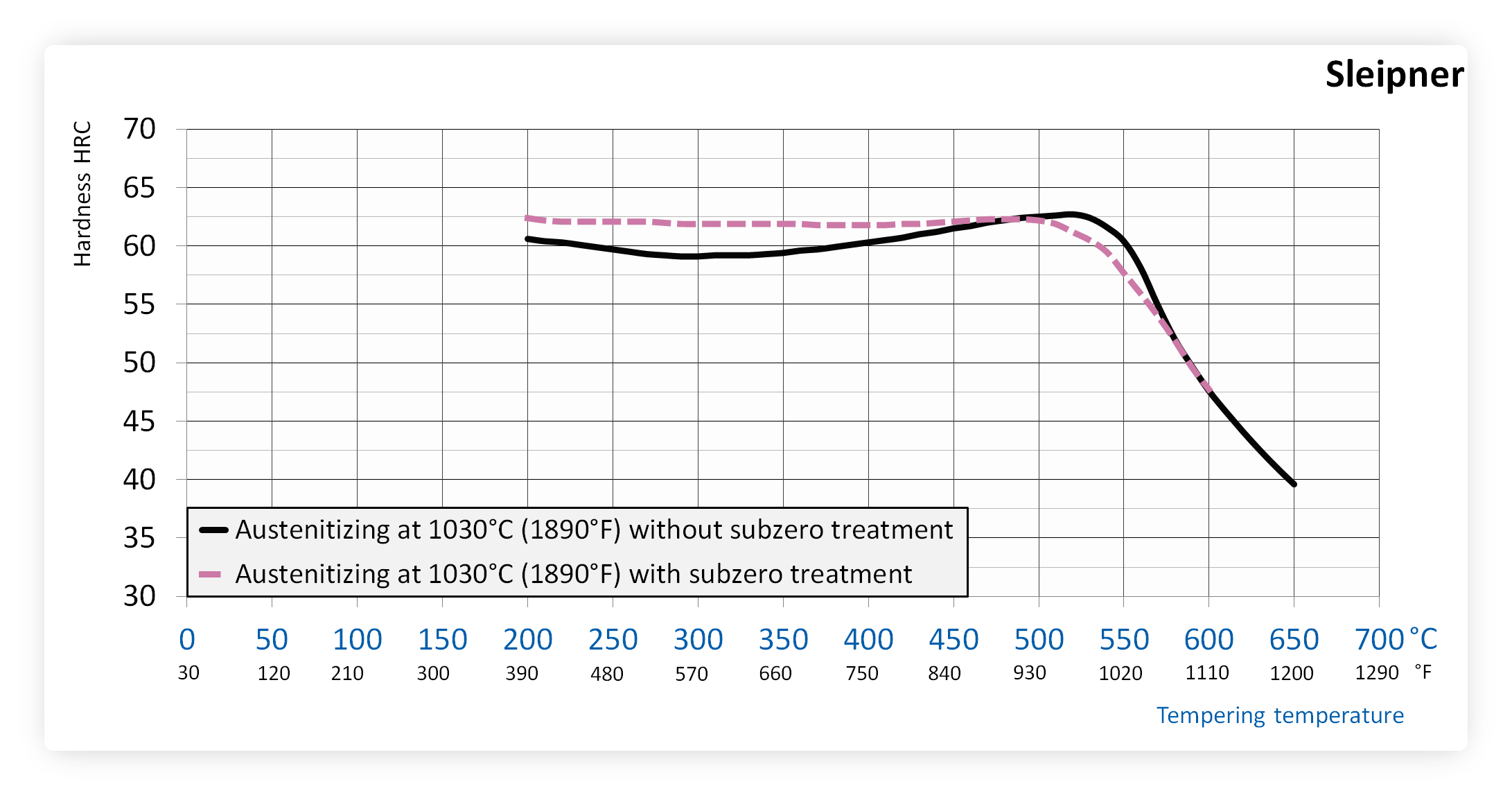
After hardening, Sleipner steel can be subjected to sub-zero treatment. Sub-zero treatment reduces the amount of retained austenite and allows maximum dimensional stability during tempering. When tempering at low temperatures below 400°C (750°F), the use of sub-zero treatment increases hardness by approximately +1 to +2 HRC. For tools tempered at high temperatures, the increase in hardness will be small or negligible.
In the datasheet, the manufacturer does not specify an exact sub-zero treatment temperature for Sleipner, but in Uddeholm’s general material on heat treatment of tool steels we can find information that sub-zero treatment is most commonly carried out at about -80°C (-110°F) or -196°C (-320°F).
Sub-zero treatment should be performed after hardening and before tempering. In practice, this process is an extension of hardening to a lower temperature, so any delay between hardening and sub-zero treatment may reduce its effect.
Tempering of Sleipner Steel
Tempering is the controlled reheating of a hardened blade to a chosen temperature and holding it for a set time to reduce brittleness and stresses from hardening and increase the knife’s impact toughness.
The steel should be tempered immediately as soon as its temperature after hardening reaches 50–70°C (120–160°F).
To achieve maximum dimensional stability and ductility, temper at a minimum of 540°C (1000°F) and use a triple tempering cycle.
Tempering at temperatures below 540°C (1000°F) may to some extent increase hardness and compressive strength, but also reduce resistance to cracking and lower dimensional stability. The manufacturer states in the datasheet: "However, if lowering the tempering temperature, do not temper below 520°C (970°F)."
For double tempering, the minimum holding time at temperature is 2 hours for each cycle.
For triple tempering, the minimum holding time at temperature is 1 hour for each cycle.
Sleipner Steel Tempering Chart
The chart is given for the following parameters: austenitizing at 1030°C (1890°F) / 30 min / cooling in forced air; tempering 2 × 2 h; quenched sample with dimensions 15 × 40 × 40 mm. With and without cryogenic treatment options.
For more details about the heat treatment process, including charts for other hardening temperatures, please visit the manufacturer's website: Uddeholm.
Comparison of Sleipner Steel with Other Knifemaking Steels
Sleipner Steel vs. D2 Steel
D2 steel is known for its high wear resistance, but Sleipner offers better toughness, which reduces the risk of chipping. For this reason, Sleipner is often preferred for outdoor knives where toughness is crucial.
Sleipner Steel vs. A2 Steel
Compared to A2 steel, Sleipner features higher hardness and better wear resistance. A2 steel, however, may offer better overall toughness. Additionally, Sleipner is more resistant to corrosion, making it suitable for use in humid environments.
Sleipner Steel vs. Elmax Steel
Elmax has similar wear resistance to Sleipner but offers better corrosion resistance. Nevertheless, Sleipner is a more economical choice for knifemakers looking for a solid material with good toughness and resistance to chipping.
Applications of Sleipner Steel in Knifemaking – Best for Various Types of Knives
Hunting Knives
Hunting knives made from Sleipner steel are excellent for skinning and other hunting tasks because they maintain their sharpness during prolonged use. However, proper maintenance of the knife must be remembered, as Sleipner steel is not stainless steel.
Outdoor and Survival Knives
Outdoor and survival knives made from Sleipner steel are very durable and resistant to chipping, making them perfect for wilderness expeditions. Sleipner requires less frequent sharpening, which is practical for extended use in the field.
How to Care for a Knife Made of Sleipner Steel?
Although Sleipner steel has higher corrosion resistance than steels like D2, it still requires proper care:
- Cleaning – Thoroughly clean and dry the knife after each use.
- Oiling – Regularly applying a protective oil layer minimizes the risk of corrosion.
- Sharpening – Using diamond or ceramic stones allows for maintaining the perfect edge.
Availability of Steel Sleipner
IK STAL stocks and supplies steel grade Sleipner in the form of flat bars, plates and cut-to-size blanks.
Material is available directly from our warehouse in Poland.
International Supply and Shipping
Steel
Sleipner is supplied by IK STAL to customers across Europe,
including the United Kingdom and selected non-European markets.
Orders are shipped from Poland regardless of local steel standards, naming conventions or customs procedures.
Where to buy Steel Sleipner?
Steel grade Sleipner can be purchased directly from IK STAL.
We supply tool steel Sleipner to industrial and craft customers across
Europe and selected non-European markets, offering cut-to-size formats
without minimum order quantities.
Summary – Why Choose Sleipner Steel?
Sleipner steel is a unique material that combines high hardness, wear resistance, and toughness, making it an excellent choice for hunting and outdoor knives. Thanks to its structure, Sleipner is easy to work with while ensuring long-lasting edge retention.
Choosing Sleipner steel guarantees durability, ease of maintenance, and high performance, making it one of the best materials for knives with a wide range of applications.
Sleipner steel stands out due to its balanced properties of hardness, wear resistance, and toughness, making it ideal for demanding cutting applications.
Sleipner steel achieves a hardness in the range of 59-62 HRC after proper heat treatment, ensuring excellent edge retention and durability.
Sleipner steel is ideal for hunting, outdoor and heavy-use knives due to its toughness, wear resistance, and corrosion protection.
Sleipner steel is relatively easy to sharpen compared to some high-alloy steels, and using diamond or ceramic stones yields the best results.
A knife made from Sleipner steel should be regularly cleaned, dried, and oiled to prevent corrosion and maintain its performance.